
Introduction
Let’s be honest: is there any feeling better than seeing a text message that says, “Hey, so sorry, but can we reschedule our dinner plans?”
For many of us, that moment brings a wave of pure relief. If you just nodded your head, you aren’t anti-social. You are likely just experiencing the “introvert hangover”—especially right now.
We have just survived the loudest time of the year. Between Thanksgiving family gatherings, office Christmas parties, and New Year’s Eve countdowns, our social energy is completely drained. That is exactly why World Introvert Day falls on January 2nd. It is perfectly placed right after the holiday chaos to give us permission to finally slow down.
To discover more meaningful celebrations and keep up with your calendar, check out our full collection of World Important Days.
This day isn’t just about staying home; it is a celebration of a different way of existing. Being an introvert isn’t a weakness that needs to be “fixed.” In this post, we are exploring how to protect your energy and embrace the power of quiet in a world that often refuses to stop talking.

What Does it Actually Mean to be an Introvert?
Before we dive into self-care, we need to clear up the confusion. There are millions of searches every month asking “Am I an introvert?” because the definition is often misunderstood.
Busting the Myths
First, being an introvert is not the same thing as being “shy.” Shyness is a fear of social judgment. Introversion is simply a preference for lower-stimulation environments. You can be a confident, public-speaking introvert who just happens to need a nap afterward. You don’t hate people; you just prefer them in small doses.
The Battery Analogy
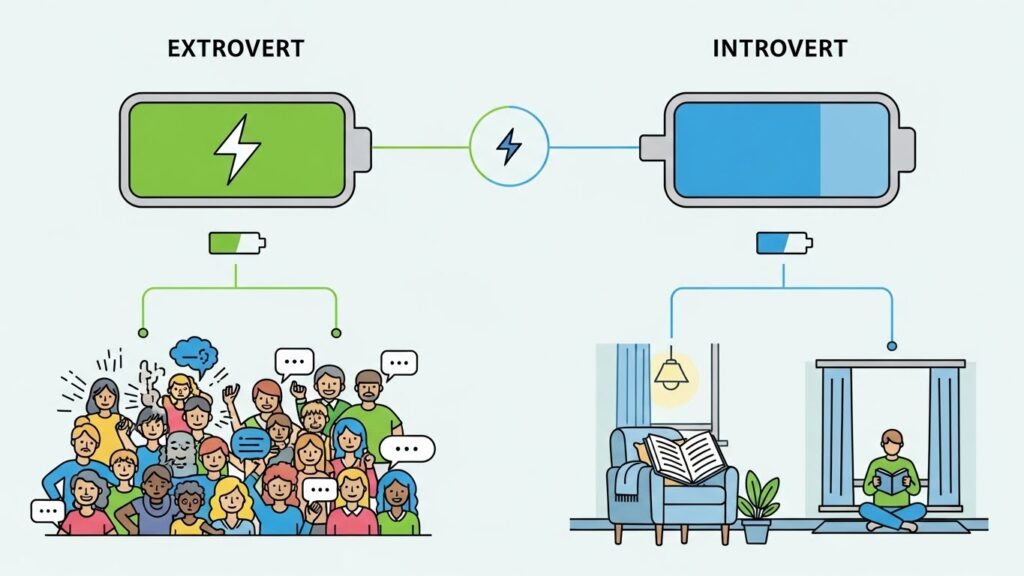
The easiest way to explain this to your friends or family is the Social Battery concept.
- Extroverts are like solar panels. They need to be out in the world, interacting with people, to generate energy. Isolation makes them feel drained.
- Introverts are like rechargeable batteries. We spend energy when we interact. To recharge, we must plug into a power source of solitude.
Why It Matters
In the USA, we live in a “Hustle Culture.” We are often taught that the person who speaks the loudest and networks the most is the “winner.” This can make quiet people feel like they are doing something wrong. But understanding your introvert personality traits is crucial. When you stop fighting your nature and start honoring your need for rest, you stop burning out and start thriving.
The Hidden Superpowers of Introverts
Society might celebrate the loud, but there is a massive advantage to being the observer. Some of the world’s most successful people—from Bill Gates to J.K. Rowling—are introverts who used their natural traits to change the world. Here are your hidden superpowers:
1. Deep Thinking and Problem Solving
While others are busy talking over one another in a meeting, the introvert is usually listening. Because introverts process information internally, they are excellent at critical thinking. They observe the details others miss and often speak up only when they have a fully formed, valuable solution.
2. Unmatched Creativity
Solitude is the breeding ground for creativity. When you aren’t distracted by constant social noise, your brain has the space to wander and invent. This is why so many writers, artists, and innovators identify as introverts. Your best ideas don’t come from brainstorming sessions; they come from the quiet moments in between.
3. Quality Over Quantity
Introverts rarely have surface-level friendships. They prefer deep, meaningful connections. While an extrovert might have 50 acquaintances, an introvert focuses on 3 or 4 ride-or-die friends. This ability to build deep trust and empathy makes introverts incredible leaders and partners.

Essential Self-Care Tips for a Loud World
To survive in a noisy world, you need a strategy. Self-care for introverts isn’t just about bubble baths; it is about boundary management. Here are four essential habits to protect your peace.
1. Master the Art of Saying “No” (and Embrace JOMO)
The fear of missing out (FOMO) is real, but have you tried the Joy of Missing Out (JOMO)? JOMO is that satisfying feeling you get when you skip a busy event to stay home in your pajamas. It is the realization that you are not “missing” anything; you are gaining rest.
How to decline politely: You don’t need a fake excuse. Keep it simple and honest.
- Script: “Thank you so much for the invite! I’ve had a really long week and I need to recharge this weekend, so I won’t be able to make it. Have a great time!”
2. Create a “Sanctuary” Space
Every introvert needs a physical location where they can let their guard down. This is your recharge station.
- The Setup: It doesn’t have to be a whole room. It can be a comfortable armchair in a corner, a window seat, or even a cozy spot on your patio.
- The Rules: When you are in this space, you are “off the clock.” Fill it with soft textures (blankets, pillows), warm lighting (lamps instead of overhead lights), and things that make you happy, like books or plants.

3. The Digital Detox
Your phone is a “socializing machine” that lives in your pocket. Even scrolling through Instagram or replying to WhatsApp messages drains your social battery because your brain is still processing other people’s lives.
- The Tip: Try a “Phone-Free Hour” before bed. Put your phone in another room. This stops the constant flow of information and allows your brain to actually rest.
4. Scheduled “Me Time”
If you don’t schedule rest, society will schedule work for you.
- The Strategy: Treat your alone time like a doctor’s appointment or an important work meeting. Mark it on your calendar as “Busy.” If someone asks if you are free during that time, you can honestly say, “I have an appointment.” You don’t have to explain that the appointment is with yourself and Netflix.
Navigating Work and Social Life
Being an introvert doesn’t mean you can’t be a great employee or partner. It just means you need to navigate these relationships differently.
At Work: The Headphone Shield
Open-plan offices are an introvert’s nightmare.
- The Trick: Wear large, over-ear headphones. Even if you aren’t listening to music, they act as a universal “Do Not Disturb” sign.
- The Solo Lunch: Don’t feel guilty about eating lunch alone. That 30-minute break is crucial for resetting your brain so you can be productive in the afternoon. Step outside for fresh air or sit in your car if you need total silence.
In Relationships: Communication is Key
Extroverted partners often misunderstand silence as anger. They might think, “Are they mad at me?” when you are really just thinking, “I am exhausted.”
How to communicate without hurting feelings: Reassurance is the secret ingredient.
- Script: “I love spending time with you, but my social battery is at 0% right now. I’m not mad, I just need an hour of quiet time to reboot so I can be fun to be around again.”

Conclusion
As we celebrate World Introvert Day, remember that your quiet nature is a feature, not a bug. In a world that can’t stop talking, your ability to listen, think deeply, and find peace in solitude is a rare gift.
You don’t need to change who you are to fit in. You just need to value your energy enough to protect it. So, this January 2nd, cancel those plans, pour a hot cup of tea, and enjoy the silence. You earned it.
How do you plan to celebrate World Introvert Day? Let us know your favorite way to recharge in the comments below!
It’s refreshing to see introverts’ superpowers highlighted in this post. I’ve always believed that introverts’ deep thinking and creativity are often undervalued in today’s fast-paced world. I’m curious, though, what are some ways to cultivate those strengths without feeling overwhelmed by external pressures?
Thank you so much for this thoughtful comment! I completely agree—those quiet strengths are often the ones that change the world.